Answering what a SCOBY is and isn’t.
When you google, “What is a SCOBY,” you’ll often get the same answer from 30,000 feet. “A S.C.O.B.Y. is an acronym which stands for Symbiotic Culture of Bacteria and Yeast and is the culture that transforms sweet tea into kombucha.”
Well, the kombucha culture or SCOBY is a colony of living bacteria and yeast. When looking at a SCOBY, you will usually be looking at liquid kombucha starter tea and a kombucha pellicle. The B.Y. in SCOBY, the bacteria and yeast, are microscopic, so you can’t see them. But they are there, living in both the liquid of the kombucha starter tea and the kombucha pellicle.

Pretty straight forward, right? Well, we’re not done. Adding to this, the kombucha pellicle or cellulose mat is almost always called the SCOBY. This is where it gets a little confusing. So let’s rephrase the above sentence with this logic.
See where we are going with this? The word SCOBY being used interchangeably can get confusing. You may find yourself having two different conversations without clarification. This post isn’t necessarily meant to be a lesson in semantics as the dual usage is commonplace. We say call it whatever you want, but it’s essential to understand the difference. Let’s do it again;
Now that we understand the difference, let’s go over each one.
“Kombucha Starter Tea” is a raw aged kombucha that contains the living bacteria and yeast needed to brew kombucha. This liquid kombucha culture is usually taken from a previous batch of kombucha and is then used to kick start a new batch of kombucha, hence the name starter tea. Starter tea is a phrase that differentiates matured kombucha from freshly inoculated, particularly referencing the matured kombucha that is used as the inoculum for a new batch of kombucha.
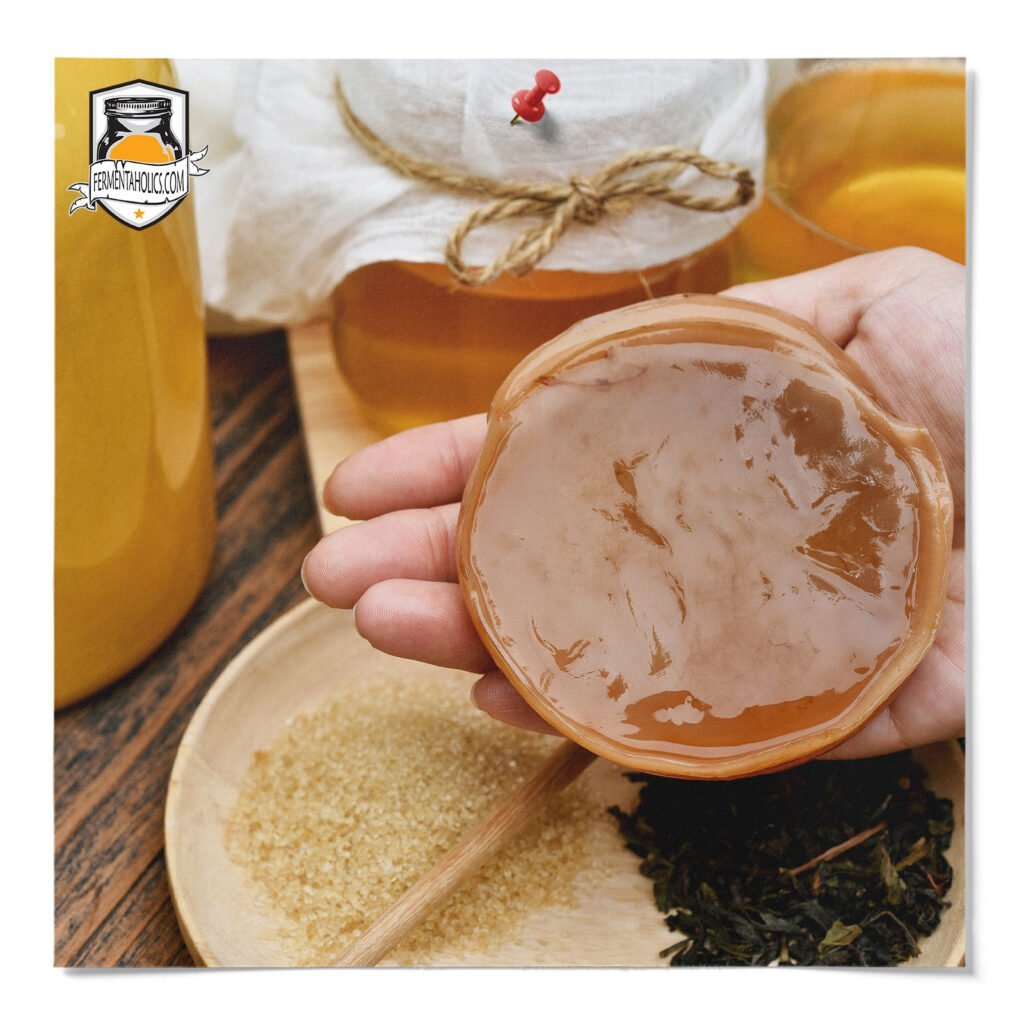
As we went over previously, the pellicle goes by many names. It is called the SCOBY, the mother, the baby, mushroom, biofilm, or cellulose mat, to name a few. When brewing kombucha, the bacteria in the culture will build a structure on the surface of your brew. The pellicle will start paper-thin and slowly thicken over time. Once the fermentation is complete, along with starter tea, you remove this structure (pellicle) and reserve to inoculate a future batch of kombucha. Despite what you may have read, the pellicle itself isn’t alive; it’s a cellulose structure made by “certain” cellulose-forming bacteria living in the culture during fermentation. It’s a byproduct of the kombucha brew. The reason for the bacteria forming this structure isn’t wholly understood. The two schools of thought are that the bacteria are attempting to seal off their food source from outsiders and to block out light. While visible, the structure isn’t alive, living bacteria and yeast do reside in it and are abundant in the liquid starter tea around it. It’s easiest to think of the pellicle as a non-living structure loaded with your beneficial bacteria and yeast.
A Kombucha SCOBY, which stands for Symbiotic Culture Of Bacteria and Yeast, is the living home for the bacteria and yeast that transform sweet tea into tangy, fizzy kombucha. It’s a cellulose-based biofilm and byproduct of the bacteria and yeasts’ metabolic processes.
The SCOBY is a crucial part of kombucha production. It serves as the medium for the fermentation process, transforming the sweet tea into kombucha.
Yes, it’s possible to brew kombucha without a physical SCOBY as the liquid kombucha (also called starter tea) already contains the necessary bacteria and yeast. However, using a SCOBY can kickstart the process and typically results in a more consistent and flavorful brew.
Yes, it’s normal for a SCOBY to have holes, tears, or uneven edges. These characteristics don’t harm the kombucha brewing process or the SCOBY’s health.
Yes, each time a SCOBY ferments a new batch of sweet tea, it will create a new layer in time that can be separated and used along with starter tea to start a new batch.
Yes, It’s best to handle your SCOBY with clean hands, free of soaps or sanitizers but you can absolutely handle it with bare hands.
Yes, a SCOBY can be cut or torn to fit into the jar without any harm. It doesn’t hurt the SCOBY as it’s a non-living structure and like all structures it doesn’t have a central nervous system.